
*as seen in North Canton Living 2026
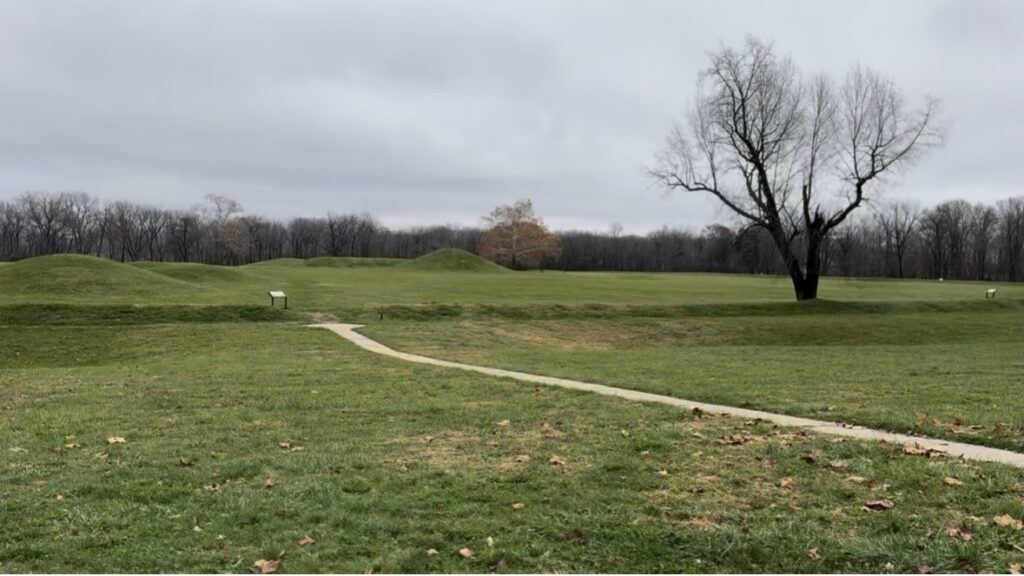
I stood in the field with the wind whipping through my hair and sneaking down my collar. I shivered under the slate gray sky while tucking my gloved hands deep into my down coat pockets. The mounds soared above me mysterious in their defiance of time. I had to wonder what life was like here 2,000 years ago. How did they stay warm in mercurial Ohio weather?
On October 14, 2023, the Hopewell Culture National Historical Park celebrated its induction into UNESCO World Heritage becoming the nation’s 25th World Heritage Site. Other cultural sites in the US include Independence Hall, Mesa Verde National Park and the Statue of Liberty. There are eight Hopewell Ceremonial Earthwork sites scattered across SE Ohio with the main visitor center in Chillicothe, Ohio.
The Hopewell people are named for Cape. Hopewell who owned the farm where part of an extensive earthwork site was excavated in 1891. Tools, ornaments and remains dating back 2000 years have been found in the excavated earthworks. By about 1,500 years ago the Hopewell way of life had ended. Only the great mounds and earthworks remain.
Archeologists found materials traded from all over North America – shark teeth from the Atlantic Ocean; conch shell from the Gulf of Mexico as well as obsidian from Idaho and Wyoming. They are hammered copper designs breast plates from the Great Lakes and mica sheets from North Carolina. This indicates a society that traveled and/or traded across the continent.
The earthworks are geometrical marvels. The Great Circle at Newark is one of the largest geometric enclosures built by Hopewell. It is nearly 1,200 feet in diameter and enclosed almost 30 acres – the equivalent of 23 football fields. The sites are thought to be of ceremonial importance. The circles, squares and octagons are sculpted to align with the sun’s annual cycles as well as the moon. While there are burial mounds within some of the earthworks, they are not thought to be villages. It is theorized they are ceremonial in nature.
What I Learned
The Hopewell culture predates bows and arrows. They did use sharpened projectiles such as a spear to hunt.
The earthworks would have taken decades to build with dirt coming from circular nearby borrowed pits. The pits were lined with clay and became ponds. The ponds were positioned in a shell pattern in relation to the mounds.
Fort Ancient is the largest of the hilltop enclosures. The tallest walls at 23 feet with four stone covered mounds forming a near perfect square with solar and lunar alignment. Fort Ancient is Ohio’s first state park.
The Octagon in Newark’s earthworks is large enough to fit four Roman Colosseums.
Serpent Mound in Peebles, Ohio is a famous effigy mound that predates Hopewell Culture. It is associated with Adena Culture.
When You Go
The earthworks spread from Newark to Lebanon, Ohio. Five of the sites are centered around Chillicothe where the main visitor center is located. High Bank Works is not open to the public as it is a research preserve.
Historical Chillicothe is also home to the outdoor drama Tecumseh. Sit under the stars and witness the story of the legendary Shawnee leader. The season typically runs from June to early September. Tecumsehdrama.com
GPS can be tricky in hilly SE Ohio. I recommend you have paper maps as a back up as well as download your GPS map before you leave.
Picnic facilities are available at each location with some limited restroom facilities. These are perfect places to stop with lunch and enjoy a quiet meal. While letting your kids run is okay, they are not allowed to run on the earthworks themselves. Please monitor your children and keep them off the mounds.
For more information, please visit https://www.nps.gov/hocu/index.htm. The National Park Service cares for Hopewell Cultural Historic Park and admission is free. Junior Ranger programs are available and can be picked up at the visitor center in Chillicothe. I highly recommend this program for your kids!