
*as seen in North Canton Living Magazine
The rain spotted my glasses and dripped down the back of my neck. Soft rain that fell gently on the desert floor. I was on a short trail designed for handicapped and education. Last night I woke up to a rollicking thunder storm that crashed around me and rocked Wilbur. In the morning I rose to another brilliant blue sky that by mid day turned dark and ominous. As I stood in the desert garden, I could see the beginning of a greening. Slight twinges of color stained the flora and fauna. I was not disappointed though - how often do you get to hike a famous desert in the rain?
Joshua Tree National Park is the meeting of the Colorado Desert and Mojave Desert. Located in southern California it is only a few hours from Phoenix. I was camped in the southern part of the park. No cell service. No services - no electricity. There was one water and dump station and two flush toilets. The campground was only fifteen miles from Interstate 10 but it felt hours away.
Joshua Tree is unique. The southern part is typical southern desert but as you gradually climb you experience changes with pockets of unique plant life. I walked though Cholla gardens of fascinating cacti. Sudden massive rock formations that looked like a giant’s play toy. An oak tree - only two of its kind in the world and they both live in Joshua Tree.
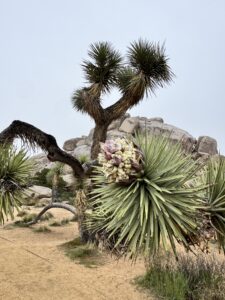
And the Joshua Tree itself. It is only found naturally occurring in the Mojave Desert. The blooms on the ends of the tree are heavy and white. In fact, after the rain, the desert popped with wild flowers and greening grass. Overnight the change was instantaneous and magnificent. Along the roads yellow, purple, and blue wild flowers sprang up carpeting the desert floor.
It was mid February and I was witnessing spring in the desert.
What I Learned
Projectile points found in the park date back four to eight thousand years ago. 10,000 years ago, when the glacial ice was melting, the park was lakes and swamps.
The teddy bear cholla cactus was beginning to bloom. In a few weeks it would be fully in bloom. While looking huggable, on each spike is an nearly invisible hook. The cactus appears to be dead with its brown stem but that is a defense mechanism.
A white oak at Live Oak Picnic area is only one of two of its kind. Considered a hybrid, there is no other oak like it in the world.
In April, the southern campground closed due to heat. It reopens in October which begins the park's busy season.
While I didn't witness a flash flood this time, I did avoid washes and gullies with the rain. Flash floods are sudden with no warning and happen frequently. The trail I was on when the rain started was on the high ground and next to the parking lot.
When You Go
Camping is available in the park and there are no hookups available. Hotels and rentals can be found in towns of Twenty Nine Palms and Yucca Valley at the northern entrances. Palm Springs is an hour away making this national park an easy day trip. Los Angeles is only three hours with Joshua Tree NP a popular weekend destination.
You will need a national park pass. Please check the national park website for the best option for your family.
Please pack your water. There are limited facilities in the park and the visitors are often closed due to heat or low staffing.
Joshua Tree National Park can be dangerous during rains as flash floods are frequent occurrences. Be mindful of your location and use the maps provided by the park. There is no cell service but a driving tour can be downloaded from the national park app. I found it an educational Experiencing the Bloom in Joshua Tree National Park